battery TESLA MODEL S 2017 (UK) User Guide
[x] Cancel search | Manufacturer: TESLA, Model Year: 2017, Model line: MODEL S, Model: TESLA MODEL S 2017Pages: 186, PDF Size: 4.67 MB
Page 154 of 186
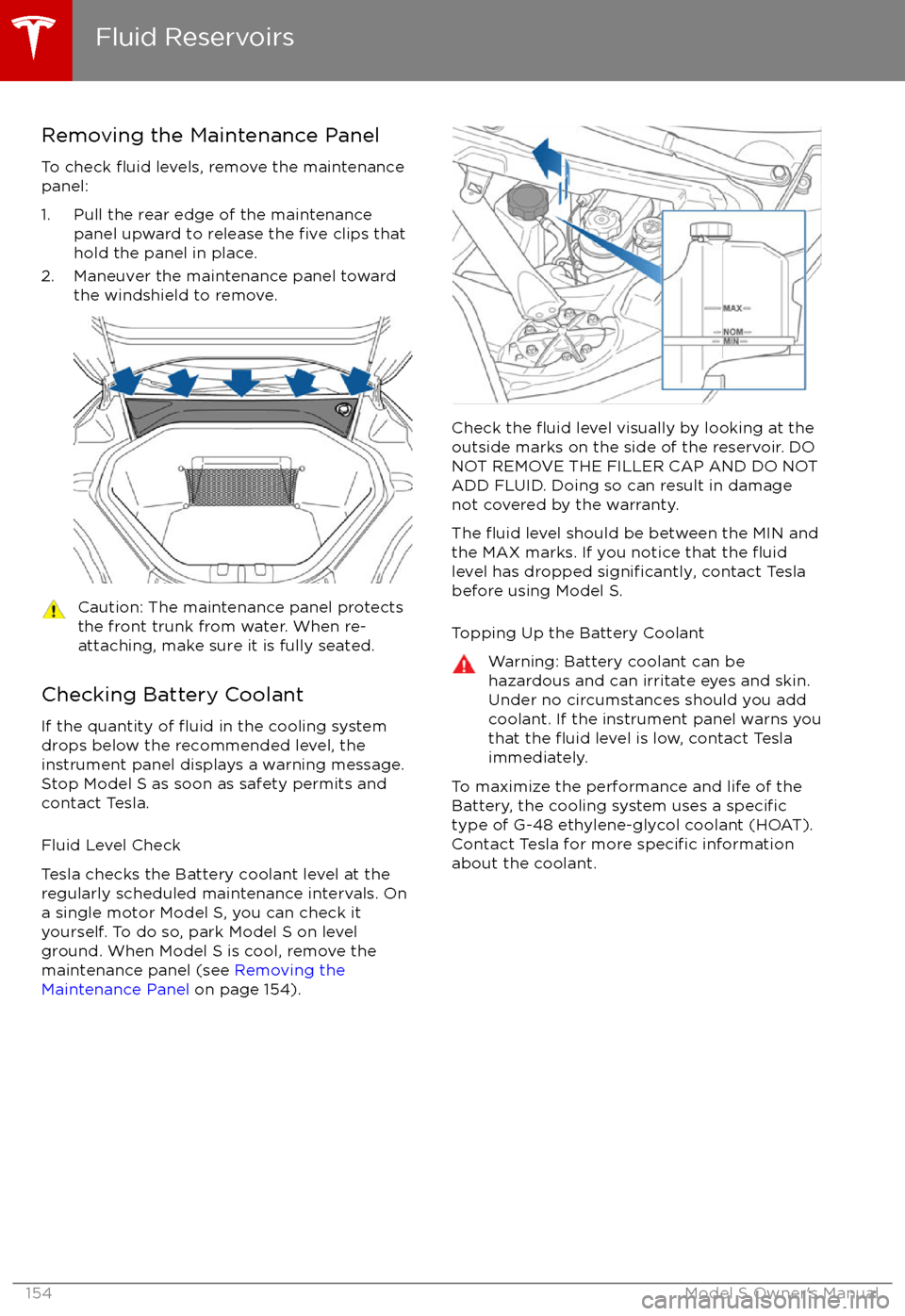
Removing the Maintenance Panel
To check
fluid levels, remove the maintenance
panel:
1. Pull the rear edge of the maintenance panel upward to release the
five clips that
hold the panel in place.
2. Maneuver the maintenance panel toward the windshield to remove.
Caution: The maintenance panel protects
the front trunk from water. When re-
attaching, make sure it is fully seated.
Checking Battery Coolant
If the quantity of
fluid in the cooling system
drops below the recommended level, the
instrument panel displays a warning message.
Stop Model S as soon as safety permits and
contact Tesla.
Fluid Level Check
Tesla checks the Battery coolant level at the
regularly scheduled maintenance intervals. On a single motor Model S, you can check it
yourself. To do so, park Model S on level
ground. When Model S is cool, remove the
maintenance panel (see Removing the
Maintenance Panel on page 154).
Check the fluid level visually by looking at the
outside marks on the side of the reservoir. DO
NOT REMOVE THE FILLER CAP AND DO NOT
ADD FLUID. Doing so can result in damage
not covered by the warranty.
The
fluid level should be between the MIN and
the MAX marks. If you notice that the fluidlevel has dropped significantly, contact Tesla
before using Model S.
Topping Up the Battery Coolant
Warning: Battery coolant can be
hazardous and can irritate eyes and skin.
Under no circumstances should you add
coolant. If the instrument panel warns you
that the
fluid level is low, contact Tesla
immediately.
To maximize the performance and life of the
Battery, the cooling system uses a specifictype of G-48 ethylene-glycol coolant (HOAT).
Contact Tesla for more specific information
about the coolant.
Fluid Reservoirs
154Model S Owner
Page 165 of 186

Brakes
Type
4-wheel anti-lock braking system (ABS)
with Electronic Brake Force Distribution,
Integrated Advanced Stability Control and
Electronic Accelerator pedal actuated
regenerative braking systemCalipersFour piston fixedRotor Diameters (ventilated)Front: 13.98”/355 mm
Rear: 14.37”/365 mmFront Rotor thicknessNew: 1.26”/32 mm
Service limit: 1.18”/30 mmRear Rotor thicknessNew: 1.10”/28 mm
Service limit: 1.02”/26 mmFront Brake Pad Thickness (excluding back plate)New: 0.354”/9.0 mm
Service limit: 0.078”/2 mmRear Brake Pad Thickness (excluding back plate)New: 0.315”/8.0 mm
Service limit: 0.078”/2 mmElectronic Parking Brake (EPB) Pad Thickness
(excluding back plate). Electronic calipers self-
adjust for pad wear.New: 0.216”/5.5 mm
Service limit: 0.039”/1 mmParking brakeElectrically actuated parking brake
calipers
Suspension
FrontIndependent, double wishbone, air spring
or coil spring/telescopic damper, sway barRearIndependent, multi-link, air spring or coil
spring/telescopic damper, sway bar (air
suspension vehicles only)
Battery - 12V
Rating33 amp-hr or higherVoltage and Polarity12V negative (-) ground
Subsystems
Specifications165
Page 166 of 186

Battery - High VoltageTypeLiquid-cooled lithium ion (Li-ion)Rating60, 70, 75, 85, 90, or 100 kWh (at
beginning of life)Nominal Voltage - 85, 90, and 100 kWh
Nominal Voltage - 60, 70, 75 kWh350 V DC
300 V DCTemperature RangeDo not expose Model S to ambient
temperatures above 140
Page 173 of 186
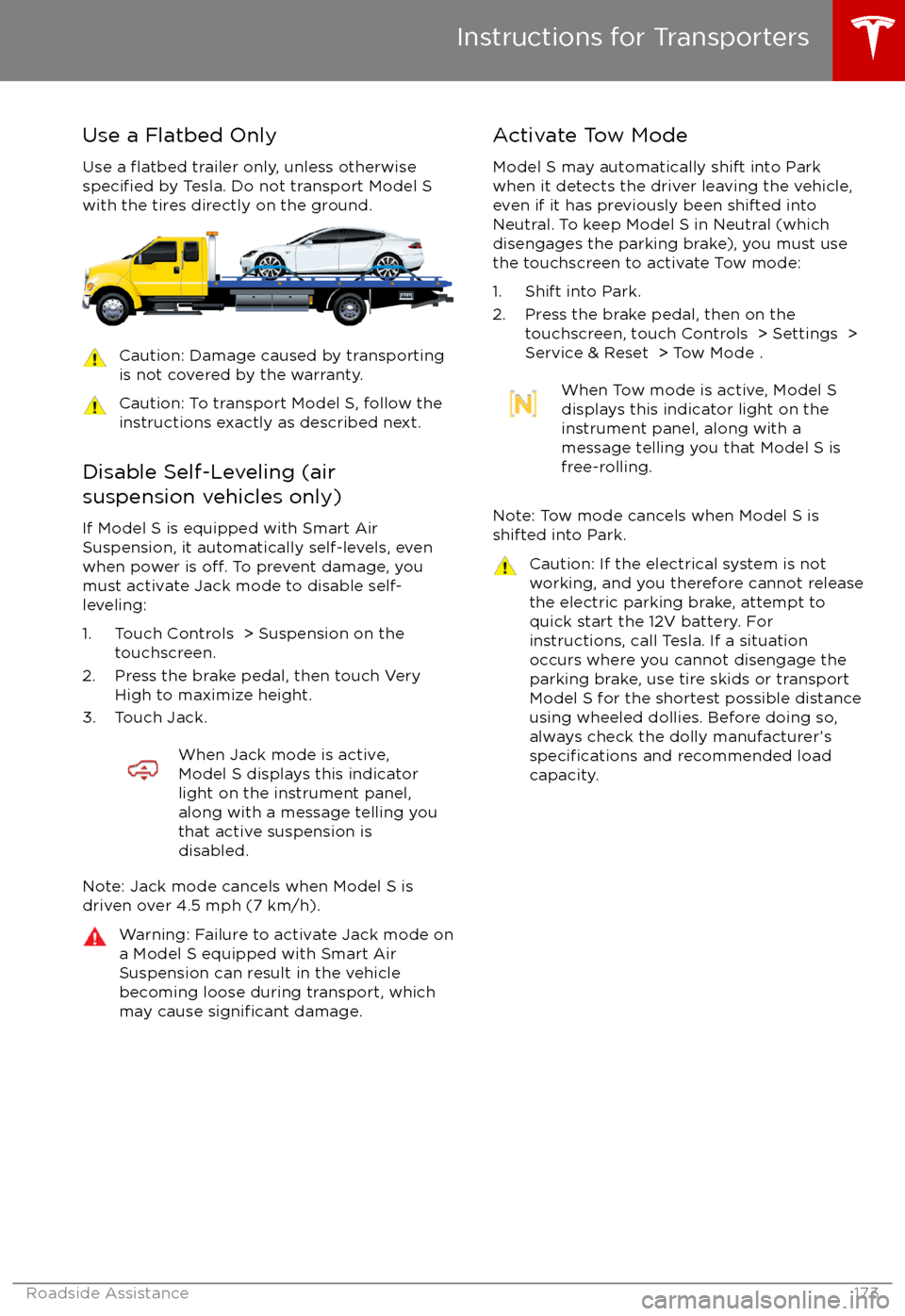
Use a Flatbed OnlyUse a
flatbed trailer only, unless otherwisespecified by Tesla. Do not transport Model S
with the tires directly on the ground.
Caution: Damage caused by transporting is not covered by the warranty.Caution: To transport Model S, follow theinstructions exactly as described next.
Disable Self-Leveling (air
suspension vehicles only)
If Model S is equipped with Smart AirSuspension, it automatically self-levels, even
when power is
off. To prevent damage, you
must activate Jack mode to disable self- leveling:
1. Touch Controls > Suspension on the touchscreen.
2. Press the brake pedal, then touch Very High to maximize height.
3. Touch Jack.
When Jack mode is active,
Model S displays this indicator
light on the instrument panel,
along with a message telling you
that active suspension is
disabled.
Note: Jack mode cancels when Model S is
driven over 4.5 mph (7 km/h).
Warning: Failure to activate Jack mode on
a Model S equipped with Smart Air Suspension can result in the vehicle
becoming loose during transport, which
may cause
significant damage.
Activate Tow Mode
Model S may automatically shift into Park
when it detects the driver leaving the vehicle,
even if it has previously been shifted into Neutral. To keep Model S in Neutral (which
disengages the parking brake), you must use
the touchscreen to activate Tow mode:
1. Shift into Park.
2. Press the brake pedal, then on the touchscreen, touch Controls > Settings >
Service & Reset > Tow Mode .When Tow mode is active, Model S
displays this indicator light on the
instrument panel, along with a
message telling you that Model S is
free-rolling.
Note: Tow mode cancels when Model S is
shifted into Park.
Caution: If the electrical system is not
working, and you therefore cannot release
the electric parking brake, attempt to
quick start the 12V battery. For
instructions, call Tesla. If a situation
occurs where you cannot disengage the
parking brake, use tire skids or transport Model S for the shortest possible distance
using wheeled dollies. Before doing so,
always check the dolly manufacturer
Page 177 of 186

Vehicle Telematics/Data Recorders
This vehicle is equipped with electronic
modules that monitor and record data from
various vehicle systems, including the motor,
Battery, braking and electrical systems. The
electronic modules record information about
various driving and vehicle conditions,
including braking, acceleration, trip and other
related information regarding your vehicle.
These modules also record information about
the vehicle
Page 181 of 186

AABS (Anti-lock Braking System) 57
absolute speed limit 91
Acceleration (dual-motor) 98
access panel, removing 154accessoriesinstalling 158
plugging into power socket 115
adaptive headlights 54
air circulation 106
air conditioning 105
air distribution 106
air
filter 108
air suspension 111
air vents 108
airbag, front passenger, disabling 35
airbags 33
alarm 125
all-season tires 142
always connected, setting 65
anti-lock braking (ABS) 57
audioplaying files 112
steering wheel buttons 39
volume control 112
Auto High Beam 54
Auto Lane Change 79
auto-raising suspension 110
automatic emergency braking 88
Autopark 81
Autopilot 68
Autosteer 76
average range 65
B
backup camera 67
battery (12V)complete discharge 133specifications 165Battery (high voltage)care of 133
coolant 154
specifications 166
temperature limits 133
battery (key), replacing 5
blind spot warning 86
Bluetoothdevices, playing audio files from 115
general information 117
phone, pairing and using 117
body repairs 158
body touch up 151
brake
fluid replacement 138
brakesautomatic in emergencies 88fluid level 155brakes (continued)overview of 57specifications 165
brightness of displays 101
C Cabin Overheat Protection setting 101
cabin temperature control 105
Calendar app 124
camera 68
camera (rear view) 67
car cover 151
car status, displaying 39, 40
car washes 149
cargo volume 163
carpets, cleaning 150
CE
certifications 179
CHAdeMO 132
chains 142
change of ownership 104
charge port 134
charge port light 135
chargingcharge settings 135
components and equipment 131
instructions 134
public charging stations 132
scheduling 135
status of 137
charging locations, finding 120
child protectiondisabling liftgate and rear door handles 7
disabling rear window switches 9child seatscleaning 150
disabling front passenger airbag 35
installing and using 22
Tesla built-in rear facing 29
cleaning 149
climate controls 105
Cold Weather controls 98
collision avoidance assist 88
console12V power socket 115
cup holders 16
USB ports 115
consumption chart 65
contact informationroadside assistance 170coolantBattery, checking level of 154
Battery, replacement interval 138
copyrights 175, 176
Creep 98
cruise control 70
cup holders 16
Index
Index181
Page 183 of 186

heating 105height adjustments (suspension)auto-raising 110
automatic and manual settings 111
disabling (Jack mode) 111
high beam headlights 54
high voltageBattery specifications 166
components 131
safety 138
hills, stopping on 62
hitches 161
Home location 122
HomeLinkFCC certification 180
programming and using 126
hood 12
horn 39, 41
I
IC
certifications 179identification labels 159
Insane setting (dual-motor) 98
instant range 65
instrument panelcharging status 137
cleaning 150
overview of 45interiorcleaning 150
dimensions 162
lights 51
overview 2
temperature control 105
Internet radio 114
intrusion detection 125
ISOFIX child seats, installing 26
J
J1772 132
Jack mode 111
jacking 157
K
keyFCC and IC certifications 179
how to use 4
key not inside 43
ordering extras 5
replacing battery 5
keyless entry 4
LlabelStatutory Plate 160
Tire and Loading Information 160
lane assist 86
lane change flash 55
lane change, automatic 79
lane departure warning 86
Language & Units 101
language setting 101
Launch Mode 63
liftgateadjust opening height 10
opening 10
lifting 157
lightsadaptive headlights 54
hazard warning 55
headlights after exit 54
turn signals 54
load limits 160
location-based suspension 110
locking and unlocking doors 4
Ludicrous setting (dual-motor) 98
lumbar support 17
M
maintenancebrake fluid, checking 155
cleaning 149
daily and monthly checks 138
fluid replacement intervals 138
panel, removing 154
replacing wiper blades 152
service intervals 138
tires 139
washer
fluid, topping up 156
washer jets, cleaning 152
map updates 123
maps 119
mats 151
Max Battery Power 98
media 112
mileage upon delivery 177
mirrors 42
mobile app 130
Mobile Connectordescription 132
using 134
modifications 158
N
naming 104
navigation 119
Index
Index183
Page 185 of 186

steering wheeladjusting position 39
adjusting sensitivity 39
buttons 39
heated 39
scroll bars 39
steering, automatic 76
summer tires 142
Summon 81
sunroof 15
suspension 111
suspension
specifications 165
T
telematics 177
temperatureBattery (high voltage), limits 133
cabin, controls for 105
heated steering wheel 41
outside 45
tie-down straps 174
tilt detection 125
Tire and Loading Information label 160
tire noise 142
Tire Pressure Monitoring SystemFCC certification 180
overview of 143
tire pressures, checking 139
tire repair kitinflating with air only 147inflating with sealant 146
replacing the sealant canister 148tiresall-season 142
balancing 140
chains 142
inspecting and maintaining 140
pressures, how to check 139
replacing 141
replacing a tire sensor 143
rotation 140
specification 167
summer 142
tire markings 168
tire sealant 145
winter 142
toll system transponders, attaching 158
tolls, avoiding 120
torque
specifications 164
touch up body 151
touchscreenclean mode 150
cleaning 150
Controls 98
overview 93
Settings 101
software updates 129Tow mode 173
towing 173
towing a trailer 161
towing eye, locating 174
towing instructions 173TPMSFCC certification 180
overview of 143
traction control 59
trademarks 175, 176
Traffic-Aware Cruise Control 70Traffic-Based Routing 120
trailer hitches 161
transmission
specifications 164
transponders, attaching 158
transporting 173
trip chart 65
trip meter 64
trip overview 120
trip planner 120
trunk, front 12
trunk, rearchild protection lock 7
disabling interior handle 7
TuneIn radio 114
turn signals 54
Typical range 101
U ultrasonic sensors 68
Unlock on Park 4
unlockingtrunk, front 12
trunk, rear 10
unlocking and locking doors 4
unlocking when key doesn